
Multi-Drug Resistant 1 (MDR1) Mutation Overview
Multi-Drug Resistant 1 (MDR1) Mutation Overview
Purpose: To provide basic knowledge and review for clients with more susceptible dog breeds.
Overview
WHITE FEET, DON'T TREAT?
In the recent past, it was a common rule of thumb that if dogs had white feet, they should not be treated with specific drugs. As the veterinary community began recording observations with assistance from pharmaceutical companies, more grants were awarded to research this phenomenon. From the initial observations, this condition was most prevalent in Herding Dog Breeds – primarily from the collie lineage. Initial observations included reactions to dewormers with the primary ingredient, Ivermectin, and reactivity to anesthesia drugs. Through several years of research, the MDR1 variant was revealed. Multidrug Resistance 1 (MDR1) drug sensitivity is the result of a genetic variant that can place dogs at risk of severe or life-threatening complications after taking medications at specific doses. Treatment focuses on prevention by avoiding or lowering the dosages of drugs that may cause side effects in dogs who have this genetic variant. Genetic testing is the most helpful tool for diagnosing MDR1 drug sensitivity. Interestingly enough, it can also be found in 4% of cats. The first MDR1 test was developed by a team of researchers at Washington State University led by veterinary pharmacologist Dr. Katrina Mealey. An MDR1 test will determine if a dog or cat’s DNA contains a specific mutation in the MDR1 gene that makes the animal susceptible to adverse drug reactions.
Cause
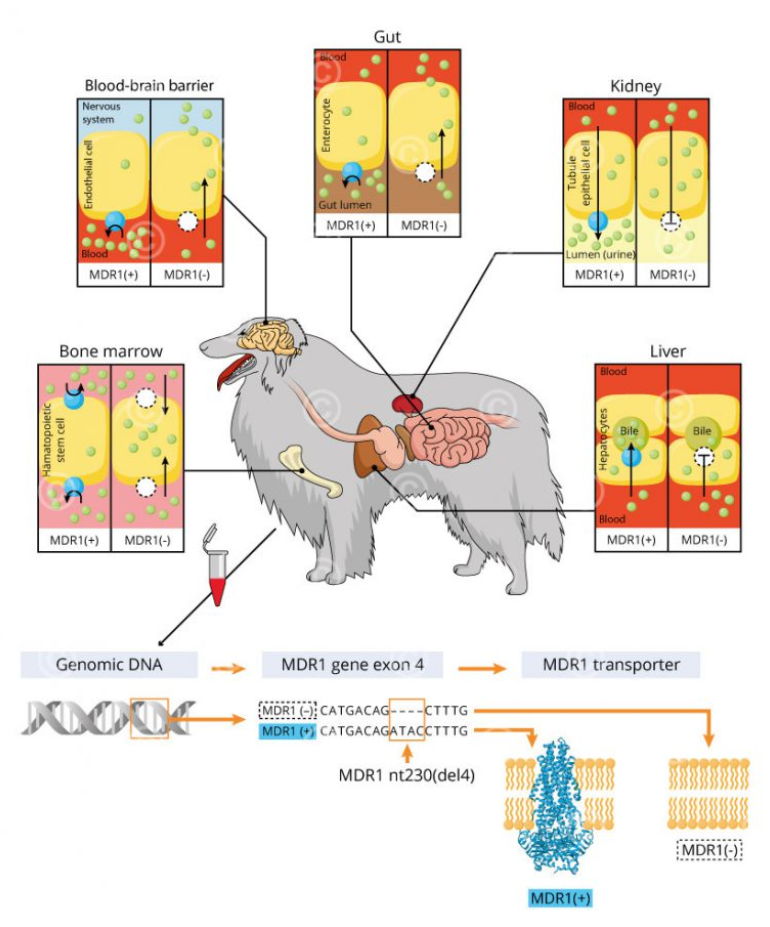
MDR1 drug sensitivity occurs when dogs inherit a 4 base-pair (bp) deletion variant/mutation in their ABCB1 gene (formerly the MDR1 gene). The mode of transmission for this mutation is autosomal recessive. This variant causes a change in a protein called P-glycoprotein (P-gp). Under normal conditions, the protein helps eliminate drugs after administration and helps keep specific substances — including some drugs and toxins — out of the brain and other organs. However, when P-gp is not functioning correctly, these drugs and toxins can build up or even cross into the brain, causing severe and sometimes fatal reactions. Basically, the functionality of the MDR1 mutation can be seen in the lipid bilayer of the plasma membrane. Without the mutation, chemicals can be transported across the membrane – flushing out of the cell. With the mutation, the transmission channels get “clogged” with drugs, and they cannot be flushed from the cells, allowing a buildup of toxins in the cells. See Figure 1.
Figure 1. Physiology of MDR1 Mutation.
(www.medicalgraphics.de)
Prevalence of Mutation
It is generally advised to genotype dogs at risk before treating them. However, there seems to be a discrepancy between the advice and current veterinary practices, as a recent study in Belgium and the Netherlands showed that most veterinarians never order a DNA test. To assess the possible risk of not testing for multidrug sensitivity in a clinical setting, the ABCB1-1Δ variant allele frequency was established in a sample of 286 dogs from a veterinary clinic. This frequency was compared to the allelic frequency in 599 samples specifically sent for genetic testing. While the allelic frequency in the sample for genetic testing was high (21.6%) and in line with the general reports, the allelic frequency in the clinical setting was low (0.2%), demonstrating an enormous difference between laboratory and clinical frequencies. Because of the low frequency of the disease-causing variant in the general clinical population, the risk of encountering a dog displaying multidrug sensitivity despite not genotyping seems to be low. As the variant was only found in an at-risk breed, the current recommendation of routinely genotyping at-risk breeds before treatment seems justified.” (NIH, 2022)
Genetics / Testing
Two facilities will perform the genetic test for MDR1. The University of California-Davis and Washington State University. Multidrug Sensitivity (MDR1) | Veterinary Genetics Laboratory (ucdavis.edu) and MDR1 testing | Program in Individualized Medicine | Washington State University (wsu.edu) The cost generally runs between $55 to $100 per dog. When registered, the testing agent will send sterile swabs to be used to collect cheek tissue. Once the sample is collected, swabs will be returned promptly for testing. Turnaround time is typically 14 – 21 days (about 3 weeks). Results from genetic testing will be explained using language such as:
- Dogs with an N/N genotype are expected not to have multidrug sensitivity. They cannot transmit this ABCB1 variant to their offspring.
- Dogs with the N/ABCB1 genotype will transmit this MDR1 variant to 50% of their offspring. Matings between two carriers of MDR1 may, on average, produce 25% of puppies with multidrug sensitivity.
- Dogs with ABCB1/ABCB1 genotypes are homozygous for this MDR1 variant and will exhibit multidrug sensitivity even at low doses.
If a pet is genetically tested through the www.embarkvet.com company, the MDR1 variant is included in all testing options and is not a standalone test. Other testing options may also be available.
The ABCB1 gene encodes P-glycoprotein, determining its base-level functionality. A dog may be severely affected by drug sensitivity if they inherit two copies of the ABCB1 variant, giving them only an abnormal P-gp. Dogs can still experience drug toxicity even with just one copy of the variant, but the effects are generally less severe. If parents' genotypes are known, a puppy can be cleared of MDR1 by parentage. With MDR1-negative parents, it is still a recommendation to spot-check periodically for verification. Because MDR1 drug sensitivity can be easily managed after it is identified, eliminating all dogs with this variant from a breeding program is not recommended.
Breed predisposition
The MDR1 variant is most commonly found in herding breeds, including, but not limited to the following:
- Collies
- Australian Shepherds
- American Shepherds
- German Shepherds
- Shetland Sheepdogs
- Old English Sheepdogs
Clinical signs
The most common signs of drug toxicity in dogs with MDR1 drug sensitivity include:
- Vomiting
- Weakness
- Uncoordinated movement
- Tremors
- Seizures
- Blindness
- Death
Drugs of Concern
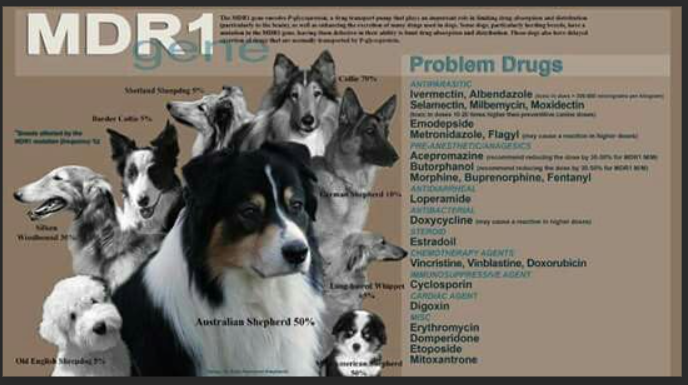
P-gp affects the absorption, elimination, and distribution of many drugs, but only a few of these drugs can cause severe toxicity in animals with the MDR1 variant. For example, medications commonly used in heartworm preventatives, such as ivermectin, can cause toxicity if given in high dosages. However, heartworm preventatives are still safe for MDR1 drug-sensitive dogs to take at low, FDA-approved dosages. Cats have also been found to be intolerant to ivermectin and eprinomectin. Manufacturers of drugs containing alfaxolaner, fluralaner, ivermectin, milbemycin, moxidectin, sarolaner, and selamectin have tested these drugs for safety in patients with MDR1 mutations and are deemed safe at FDA-approved doses.
Other medications that should be used with caution and at reduced doses include sedatives like acepromazine and butorphanol, anti-cancer medications, and more. One drug that should be avoided entirely is an anti-diarrheal medication called loperamide (sold under the brand name Imodium). Additionally, antiemetics (maropitant, ondansetron), apomorphine, and galliprant should be used cautiously with affected dogs.
Certain medications, when used in combination with each other, can increase the total concentration of individual drugs and introduce more risk of an adverse reaction — even in dogs without the genetic variant. Examples include ketoconazole, cyclosporine, and spinosad (Comfortis). See Figure 2 below.
Figure 2. MDR1 Drug Listing.
(www.researchgate.net)
Treatment
There is no cure or antidote for MDR1 drug sensitivity. Treatment involves decreasing drug doses to avoid adverse reactions or choosing alternate drugs altogether. Dogs with adverse drug reactions are treated based on their symptoms and supportive care. It is important to know that not all drug sensitivities are due to the MDR1 variant, and you should talk to your veterinarian about other concerns regarding drug sensitivity.
Outcome
With proper consideration of drug interactions and dosages, MDR1 drug-sensitive dogs can live normal lives without incident. Severe and potentially life-threatening consequences can occur if drugs are taken at incorrect dosages, if they are used in certain combinations with other drugs, or if at-risk dogs are unintentionally exposed to problem drugs (e.g., ivermectin used to deworm horses).
Take Home Message
If you have a herding dog, please keep this mutation in mind. For a neuter/spay, that one-time sedation may not produce enough of a reaction to be life-threatening. However, if your pup needs multiple sedate procedures, consider having it tested for peace of mind. If the pup was purchased from a reputable breeder, contact them for testing results of the parents. “Instead of genotyping dogs and breeds at risk, veterinarians might adopt a different approach, i.e., lowering the treatment dosage to prevent toxic reactions against risk drugs. However, the recommended dosage for several treatments, such as treatment of generalized demodicosis with ivermectin, antidiarrheal treatment with loperamide, sedation with acepromazine, and lymphoma treatment with vincristine, vinblastine, or doxorubicin were all shown to cause toxicity in multidrug sensitive dogs. Lower doses of P-gp substrate chemotherapeutic drugs to treat at-risk breeds increase the chance of shorter remission duration. Overall, it is clear that lowering the dosage might reduce treatment efficacy.” (NIH, 2022)
Sources:
- https://www.vet.cornell.edu/departments/riney-canine-health-center/canine-health-information/drug-sensitivity-mdr1
- www.akc.org
- www.researchgate.net
- www.medicalgraphics.de
- Multidrug Sensitivity (MDR1) | Veterinary Genetics Laboratory (ucdavis.edu)
- MDR1 testing | Program in Individualized Medicine | Washington State University (wsu.edu)
- www.embarkvet.com
- Drug sensitivity: MDR1 | Cornell University College of Veterinary Medicine
- MDR1 FAQs - Australian Shepherd Health & Genetics Institute (ashgi.org)
- The prevalence of the ABCB1-1Δ variant in a clinical veterinary setting: The risk of not genotyping - PMC (nih.gov)